
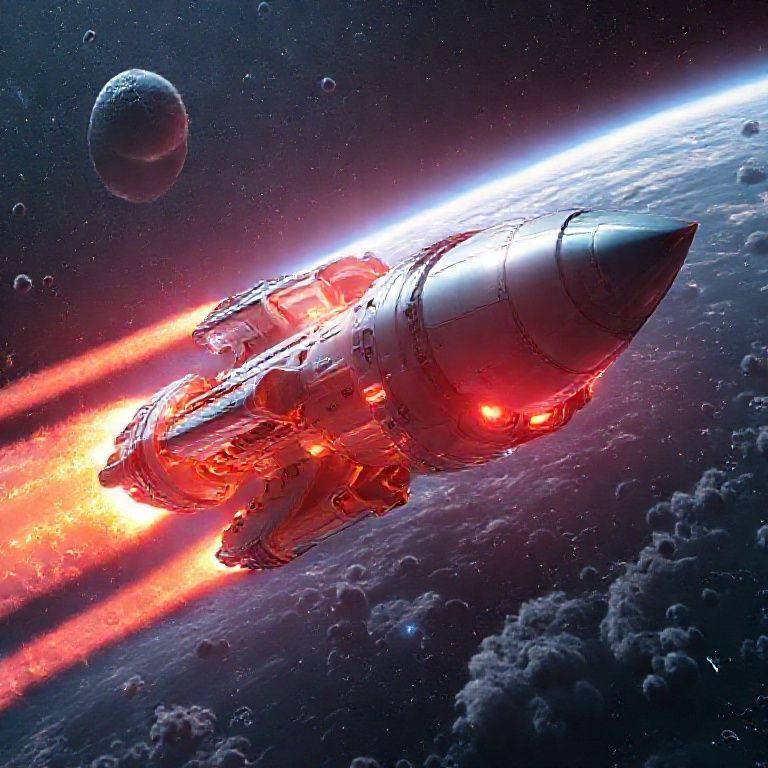
Space exploration hinges on propulsion advancements. Artificial intelligence, especially machine learning, is emerging as a key player, optimizing everything from nuclear thermal engines to plasma confinement in fusion systems. This technology promises faster, safer, and more efficient interplanetary travel, making ambitious missions to the Moon, Mars, and beyond more attainable.
Machine learning identifies patterns in data, learning from experience to improve performance. Reinforcement learning, a subset of machine learning, enables machines to develop intuitive expertise at computational speeds impossible for humans. This allows AI to optimize complex systems, like spacecraft trajectories and propulsion system designs.
AI’s role spans design and real-time operations. For instance, in nuclear thermal propulsion, reinforcement learning optimizes heat transfer between fuel and propellant. In fusion technology, AI aids in controlling magnetic fields within compact devices like polywells, essential for creating fusion conditions. These advancements are crucial for scaling up fusion for space travel.
Moreover, AI manages fuel consumption, adapting to mission changes. Spacecraft with varied capabilities, like Lockheed Martin’s LM400, benefit from AI’s ability to calculate fuel needs and optimize usage. This flexibility is vital for missions requiring rapid responses to shifting priorities, such as military applications.
From optimizing engine designs to managing fuel, AI is becoming indispensable in space exploration. By pushing propulsion boundaries and enhancing mission adaptability, AI paves the way for groundbreaking discoveries within and beyond our solar system, marking a new era in space travel.