
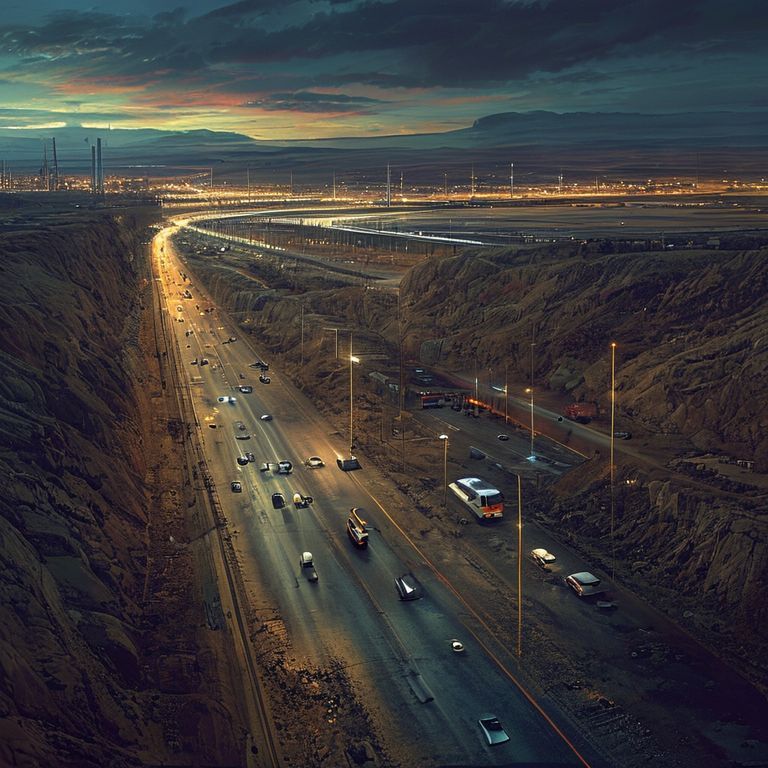
The Nevada highway leading to Tesla’s burgeoning Gigafactory near Reno is becoming a battleground of congestion and accidents, prompting Elon Musk’s Boring Company to explore a radical solution: underground tunnels. With Tesla’s expansion accelerating, the existing I-80 corridor is struggling to handle the influx of workers, suppliers, and logistics vehicles, creating gridlock that mirrors early-stage challenges at Tesla’s Texas and Nevada facilities.
The Boring Company’s potential involvement marks a strategic pivot from urban transit projects like The Loop in Las Vegas to industrial logistics. Musk has long championed tunnels as a scalable alternative to surface traffic, and Reno’s Gigafactory—set to become Tesla’s largest manufacturing hub—offers a prime test case. Unlike urban tunnels, which prioritize passenger speed, this project would focus on high-capacity freight and worker transport, potentially reducing commute times by 70% and slashing emissions from idling vehicles.
The impact could redefine industrial logistics globally. If successful, Tesla’s Reno tunnel could become a blueprint for other mega-factories, from Apple’s supply chain hubs to Amazon’s fulfillment centers. For Nevada, it’s a chance to position itself as a pioneer in smart infrastructure, attracting further investment while mitigating the environmental and economic costs of sprawling surface traffic. The project also aligns with Tesla’s sustainability goals, as tunnels eliminate the need for additional road expansion, preserving open land and reducing urban heat island effects.
“This isn’t just about moving cars faster—it’s about rethinking how we design industrial ecosystems,” says urban planner Dr. Sarah Chen of MIT. “Musk’s approach forces us to ask: Why build wider roads when we can build smarter systems?” Chen notes that while tunnels require upfront investment, their long-term efficiency gains—particularly for high-volume, predictable traffic like factory logistics—could make them the gold standard for future manufacturing hubs. Early feasibility studies suggest Reno’s geology is favorable, with stable bedrock suitable for tunnel boring.
With groundbreaking potentially imminent, the Reno Gigafactory tunnel project could signal a turning point for industrial infrastructure. Musk’s playbook—combining high-risk innovation with scalable solutions—has always been about disruption. If Boring Co. delivers on this front, it may well prove that the future of manufacturing isn’t just electric, but underground. For now, Reno drivers can only hope the digging starts soon—before their next commute turns into a nightmare.