
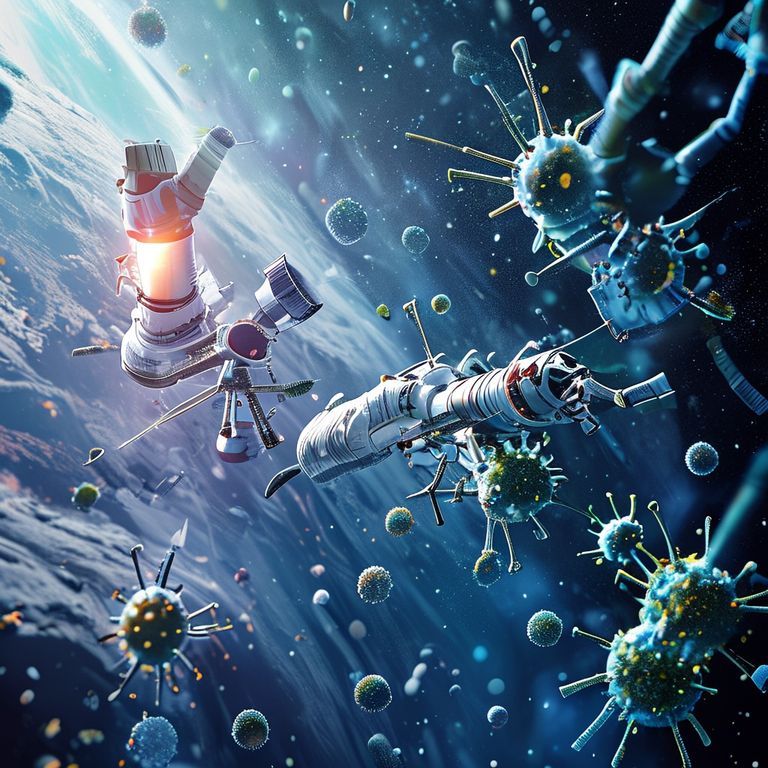
The International Space Station (ISS) isn’t just a floating lab for zero-gravity experiments—it’s also a proving ground for nature’s own antibiotics. New research reveals that bacteriophages, viruses that target and kill harmful bacteria, become significantly more potent in space. Scientists exposed these phages to microgravity and cosmic radiation, only to find they evolved faster and more effectively against drug-resistant pathogens like *E. coli* and *Salmonella*.
This phenomenon isn’t just a quirk of orbital physics; it’s a testament to how extreme environments accelerate evolutionary leaps. On Earth, bacteriophages adapt over years, but in space, their genetic mutations occur at an accelerated rate due to radiation and altered cellular behavior. Think of it like a fitness trainer for viruses—space forces them to adapt or die, leaving behind hyper-efficient killers. Comparisons to Earth-bound phages show a 20–30% increase in lethality, a game-changer for antibiotic resistance.
The implications for global health are staggering. With antibiotic-resistant infections killing nearly 1.3 million people annually, space-boosted phages could offer a sustainable alternative. Unlike traditional antibiotics, which often develop resistance, phages target bacteria with precision, leaving human cells unharmed. If scaled, this could revolutionize medicine, particularly in treating chronic infections like tuberculosis or cystic fibrosis.
Dr. Elena Rios, a microbiologist at NASA’s Ames Research Center, highlights the “unexpected resilience” of phages in space. She notes that the ISS experiments mimic conditions found in deep-space missions, suggesting these viruses could even protect astronauts from microbial threats during long-haul voyages. “We’re essentially training viruses to be better at their job,” she says, emphasizing how space research bridges biology and astrobiology.
As scientists refine this discovery, the next frontier isn’t just Mars—it’s leveraging the cosmos to fight Earth’s deadliest diseases. With phages evolving in real time aboard the ISS, the race to harness their power is on. The question isn’t *if* space will change medicine, but *how soon* we’ll see these cosmic killers in hospitals worldwide.