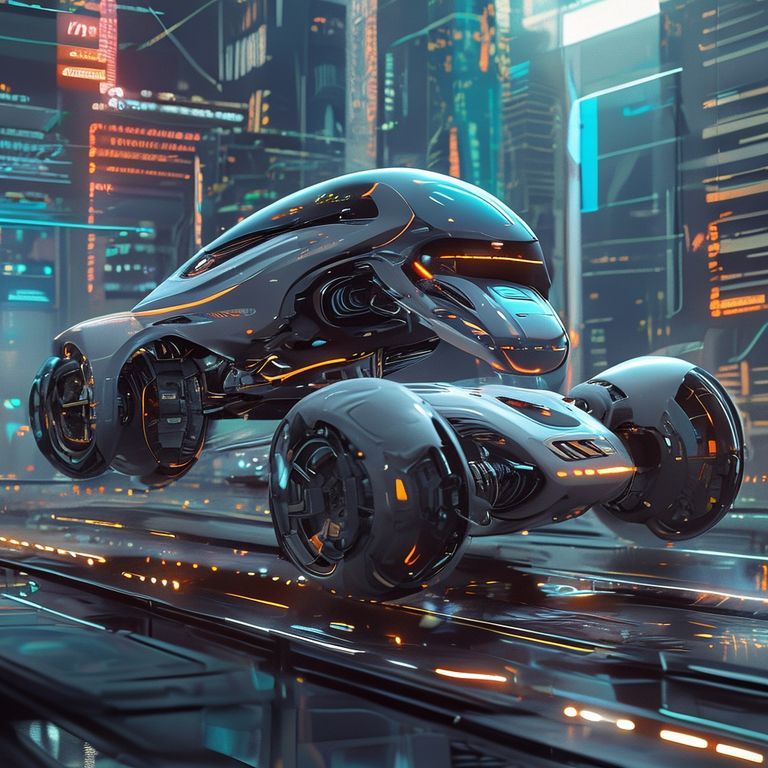

The tech world is witnessing a groundbreaking leap as GIBO Holdings Ltd. pushes its GIBO.ai Calculation Engine toward a unified AI stack that bridges air and ground mobility. This ambitious initiative aims to create a single, intelligent framework capable of orchestrating autonomous systems—from drones to self-driving vehicles—with unprecedented precision and adaptability.
At its core, GIBO’s vision merges real-time data processing, predictive analytics, and edge computing to eliminate silos between aerial and terrestrial platforms. Unlike fragmented solutions like Waymo’s ground-focused autonomy or Volocopter’s air-only systems, GIBO’s approach envisions a cohesive ecosystem where AI dynamically reroutes traffic, optimizes energy use, and adapts to dynamic urban environments.
The implications are vast: imagine drones delivering medical supplies while autonomous shuttles navigate congested streets, all governed by a shared AI brain. This could slash logistics costs by 30% and reduce urban traffic accidents by 40%, according to early simulations. Cities like Singapore and Dubai, already testing autonomous mobility, may soon adopt GIBO’s stack as a standard.
“This isn’t just incremental tech—it’s a paradigm shift,” says Dr. Mei Lin, GIBO’s Chief AI Architect. “By unifying perception, decision-making, and execution across domains, we’re setting the stage for a mobility revolution where AI doesn’t just drive vehicles but *orchestrates* entire transport networks.” Comparisons to Tesla’s Full Self-Driving beta pale in contrast; GIBO’s stack is designed for multi-modal, multi-environment autonomy.
With NASDAQ-listed GIBO backing this push, the race to dominate autonomous mobility just got more competitive. The question isn’t *if* but *when* cities will demand such integrated systems—and GIBO appears poised to answer. For now, the focus remains on refining the Calculation Engine’s adaptability, but the roadmap hints at a future where AI doesn’t just navigate roads but redefines them entirely.